Thursday, January 27, 2011

Day 4- Riding the Ridge

We are at the proverbial "halfway point" to Sunday. With each day, we have seen an increase chance in precipitation and not much change in the way of high/low temperature. We are on the cusp of getting much more data starting tomorrow. That is when multiple models start their Sunday runs. For the past 4 days I have been using extended GFS (Global Forecast System) models to forecast. GFS, NAM (North American Model) and more GFSx models will be available for use. Also, the University of Washington has a very good model system set up that uses NAM and WRF (Weather Research and Forecasting) model that specifically focus on the Pacific Northwest. That will help as well. So with more data means more information to sift through. This is where the fun really begins. But as for today's update:

Surface
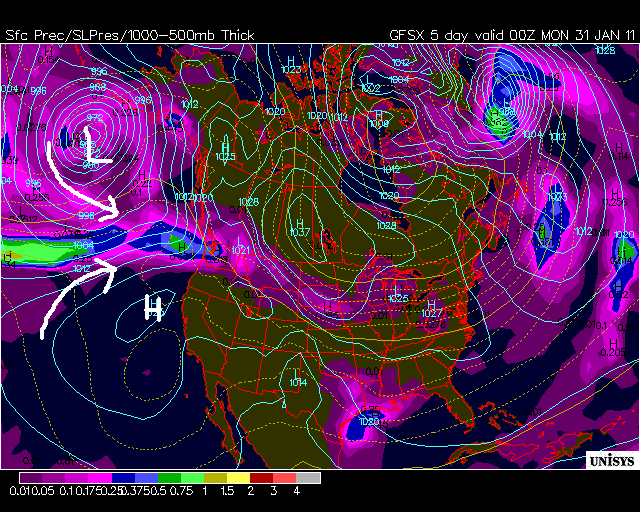
Yesterday we saw a nice batch of moisture being pushed our way with the help from high pressure to our south and low pressure to our north. Today that moisture has been pushed back into the flow of the low pressure system. That moves the precipitation to the north and removes a good chance of rain for the majority of the day Sunday. Due to this, I have removed the showers for most of Sunday.
By the way, check out the Pacific weather charts as of today. You can see that area of low pressure that will eventually make its way into the Gulf of Alaska. It's sitting out in the middle of the Pacific. Pretty neat that we can see this coming from so far away!


1000mb
I am adding a new map to the discussion today. This is the 1000mb map and is essentially a surface map. Many locations around the state would call 1000mb "ground level". What I am looking for in this map will be re-enforced all the way up to the 500mb map today, more on this in a bit.
I have highlighted a few wind vectors. Wind vectors on this map indicate direction and wind speed. The longer the arrow, the faster the winds. Notice how the winds around Oregon spread apart from one another. This indicates that wind at the 1000mb level are diverging away. This is cause when air sinks from the upper levels. When we have air sinking, once it hits the ground the only thing it can do is spread out. Sinking air also denotes stable conditions and high pressure. This is another sign that our rain chance for Sunday is diminishing at this point.


850mb

High pressure off the California coast is still the dominant feature at 850mb. The low up to the north weakened on the maps from yesterday. There appears to be little to no warm air advection on today's map. That favors more stable conditions.
500mb
That pesky shortwave makes a return in today's map but it doesn't impact our forecast. What does impact the forecast is the ridge that has been re-established. This ridge is just off the coast. I would not be surprised to see this ridge move a bit more between now and 4pm Sunday. This ridge is re-enforced at the 1000mb level. Remember the divergence of wind on that map? It is a result of this ridging.


300mb

The jet streak we saw yesterday that was set to help with the precipitation has now left. It has sagged to the south along with that shortwave energy.
All in all, day 4 has brought an improvement in the forecast. I would say the only threat of rain on Sunday will be limited to the early morning hours. The first four posts have been strictly conditions updates. Tomorrow I will get into some number forecasting as various models and text models will begin to include Sunday. As of today, my initial numbers have held up pretty well!

Wednesday, January 26, 2011

Day 3

On to day three of the forecast test. Still a few days out from getting better data for the 30th. Currently I am using just one model (something called "model-riding") but we have to get within 72 hours in order to get a look at multiple models. We are still looking at an ever-changing situation for Sunday. I am see another increase in chance for precipitation on Sunday. It doesn't look like a real big rain event, just some scattered light showers. Let's get into what has changed:

Surface
Yesterday the surface model was forecasting some moisture from the south moving into our area. Today that threat has diminished. Off the California-Oregon border, high pressure has built northward. That will interact with a developing low pressure system establishing itself in the Gulf of Alaska. In the Northern Hemisphere, high pressure is associated with a clockwise spinning rotation. Low pressure in the Northern Hemisphere is associated with a counter-clockwise rotation. Look how these two rotations interact with each other. They wind up converging right in our region. That will help send a little disturbance our way.


850mb

The 850mb map re-enforces what we see at the surface. The higher pressure that built northward is surrounded by warmer temperatures. The low pressure that has developed contains cooler temperatures. With the rotation of each system kept in mind, we see that there will be a convergence of warm and cooler air. This is what's called Warm Air Advection, areas where warm air pushes into an area of cool air. The WAA isn't strong but nonetheless it helps that we have a little to enhance uplift and some unstable conditions.


500mb
The first few models that we looked had a prominent ridge over our heads. In today's model, that ridge has flattened out a bit. Remember that shortwave that I talked about the past two days?? It has disappeared from our region. It sagged even further south and merged with a trough that was almost off the map the first few runs. The fall out of this shortwave means that we won't be getting the moisture from the south. That energy falls to Baja California. So where will we get the energy for the moisture??


300mb

Our last map reveals the new source of energy. First off, this map re-enforces the shortwave that moved south. Look at the trough that sags all the way down to Baja California. The shortwave followed this flow. Back in our region, there is nothing that impressive to look at. However, there is a small jet streak to our north. This streak is located over northern Washington and Idaho. The rule of thumb with a jet streak is this: look at the jet streak from behind it as it flows west and split the streak into quadrants (as I have done to the image below). There are two quadrants to take note when looking for weather action. The front left quadrant (known as the left exit quadrant) and back right quadrant (right entrance quadrant). These are areas of PVA, or positive vorticity advection. PVA is associated with areas of uplift, which causes air to rise, cool and condense out often leading to precipitation. Well guess where Portland is in relation to the jet streak. In the right entrance quadrant! That is right where we want to be when looking for some precipitation action. Again, our jet streak is fairly weak. Look at the jet streak out in the Pacific, that is a strong streak associated with that low pressure system up in Alaska.


As you can see, each day brings change. The atmosphere is always changing and it is easy to see why there are so many revisions to a forecast, especially during the winter months! Nonetheless, not many changes have been made to the initial forecast. It helps that this doesn't appear to be a big winter event, too! Back again tomorrow.

Tuesday, January 25, 2011

Day 2

Things have changed slightly for our forecast day, Sunday the 30th. The temperatures remain the same. In fact, the evening forecast kept the same numbers last night. The change in the forecast comes in an increased chance for rain. Let's take a look at what changed on the maps:

Let's start from the ground up.

Surface Map
Here is the latest 0Z update for the surface. We see the batch of precipitation spreading northward. Yesterday, this moisture was limited to southern Oregon. Now it has pushed its way a bit further north into our region. I have added some edits in order to highlight the areas that have undergone change.


850mb level (about 5,000 ft)

Using this map, I am looking to diagnose where areas of warm air invade areas of cool air and vice versa. Areas where warmer air is over-taking cooler air indicate instability and aid precipitation processes. Areas where cooler air is moving in will indicate stable conditions. In our situation, we aren't seeing any warm air coming in, nor is a significant amount of cool air coming in. All in all, today's map isn't all that impressive.


500mb level (18,000 ft)
As I mentioned in yesterday's post, the 500mb level is the steering mechanism for a majority of our weather systems. Yesterday, we saw a good ridge over our heads but to our south we saw a shortwave, cutoff low. In today's map, that cutoff low has weakened some. The energy is still there. The region is still centered in southern Oregon and has plenty of positive vorticity associated with it. This is a large area of uplift, which is a major part in aiding precipitation. This particular area still looks strong enough to produce some good uplift in our area, which is why I've upped the rain chance a bit. But the low was cutoff yesterday but not today. We look to the 300mb level to see why.


300mb level (30,000 ft)

This map shows the location of the jet stream as well as streaks within the jet flow. Yesterday, we saw a jet streak that was beginning to dig south. Today, it has flattened out a bit but increased in intensity. That is helping push the energy up our way. The southerly flow yesterday was a sign that the jet may dig south, allowing the cutoff low at the 500mb level to go south as well. Now that the jet has flattened out, that cutoff low will now begin to flow back up towards the north. The cutoff low itself has weakened but the jet has increased in intensity. This will be another aid to precipitation as an increase in the jet means an increase in uplift around the jet streak.


So the glaring change from yesterday to today was the intensity and location of that shortwave kink in the middle of the atmosphere. It will be interesting to watch the shortwave and see if any cold or warm air moves into the region. Also, the closer we get to our forecast day, we will have access to more model runs that will allow some comparison. I'll be back tomorrow with another look at the forecast!

Monday, January 24, 2011

7-Day Acurracy

Mark Nelsen, known around work as "The Chief", grades his forecast accuracy each week. Daily high/low temperatures and sky/precip conditions all go into his grading scale. He churns out a pretty high accuracy rate. His report card got me thinking...how accurate can we forecast seven days out? A lot of people think that meteorologists can't even forecast 1 day out so how accurate could we be seven days ahead?

In all reality, forecasting is becoming much more accurate overall. When it comes to you certain aspects of forecasting though, things can be more challenging. Take for instance winter weather. Everyone gets upset at the weatherman when says it is going to snow and then it never does. Why does it always seem that way? First, we live in a geographical area that doesn't often produce snow where we live. Being in a valley, temperatures really have to sink down to the floor in order for snow to survive. The Pacific Ocean also acts as a moderator and will warm an otherwise cold air mass that could produce snow. Water has a high heat capacity which means that it take much more energy to warm the water. Because of this, the winter time is actually when water temperatures in the Pacific are WARMEST. Another reason why forecasting winter weather is so tough? We just do not know what will happen until right before it actually happens. So many dynamics go into winter weather and it only takes the difference of a few degrees that would give us snow, rain or even freezing rain. So next time you see snow in the forecast, just be patient and keep in mind that things can (and probably will) change.

Now onto my little experiment. I've decided to track my forecast for next Sunday, the 30th, for the next seven days. We will see how much it will change and see how accurate it is. Let's look at day 1:


Ok, so seven days out I see us staying dry. Things cloud up after a decent stretch of sunny conditions. The average for January 30th is 47 degrees. I am shooting for 48 degrees. This many days out, climatology can be a decent way to forecast a high and low temperature. A lot of hi-resolution weather models do not go out 7 days so my confidence on this as of today isn't all that high. But I am, as of this moment, fairly certain we will stay dry Sunday. Here is why:

Looking at the weather charts, a good place to start is the 500mb. This is about half way up the atmosphere and gives a good estimate of where weather systems will go.


This is the 0Z (+8 hours) 500 mb model run, valid Mon. Jan 31. This is our 4 p.m. forecast for Sunday. Two things to point out. Notice the white contour lines over Oregon and Washington. They form a ridge in the overall flow. A ridge indicates a region of high pressure and often results in fair conditions. That is a pretty well-established ridge over our heads. But look to the south, right around the Oregon-California border. That is a shortwave disturbance, kind of a kink in the overall flow. Shortwaves often result in unstable weather. So we have a ridge overhead, but a shortwave of energy to the south. What will this lead to?


The map on the left is a relative humidity chart and the map on the right is what is expected at the surface. Again, these maps are all forecasting for next Sunday. On the relative humidity map, treat the lighter areas as clouds. Now look at the that bulls-eye area at the Oregon-California border. Showing a pretty good area of high relative humidity, meaning the air is close to saturation and is a stronger area of potential rain. Now turn to the surface map. There is some precipitation near the border. But in our area, we look dry. As these models update we can get a better idea of the flow and where this shortwave may actually land. It is possible this area moves a bit further north and impacts us. But as of right now, all I see are some clouds from this shortwave that could filter into our area, thus the cloudy yet dry forecast.

What do other forecasts look like for the 30th? The Weather Channel has a high of 48, low of 42 with a few showers. The National Weather Service also has a forecast high of 48 under mostly cloudy skies. So at least other people are seeing what I am seeing. I'll be back with an update on the forecast tomorrow.

Thursday, January 20, 2011

Putting A Cap on the Season

I am slowly coming to terms with seeing my favorite sports team lose in the championship game with 2 seconds to go. What a ride, nonetheless. A great season ended with a great game regardless of the outcome. The National Championship game was a classic, one of the best bowl games of the season. But in my mind, it wasn't the game of the bowl season. I'll talk about which game gets that nod in a bit. First, let's re-visit my bowl picks.

Ultimately wound up with a 20-15 record. Preeeeeety average but I'll take an above .500 season. There were a few surprises, as there usually is. I was surprised how Stanford romped, how Alabama rolled and how Oklahoma didn't get 60 on UCONN. Nebraska choked, Miami fell flat and Ohio State tried but Ryan Mallett tried harder to lose and the Bucks finally beat an SEC team.

Things that went according to plan: TCU and Wisconsin played smash-mouth football, the National Championship game was low-scoring (it always seems when all the talk is about the offense, the defenses step up), Arizona continued it's horrific 2nd half of the season. Michigan was shown by Mississippi State that it didn't belong in a New Year's Day bowl.

The bowl with the most deserving winner: Army in the Military Bowl
The bowl with the most ironic loser: Hawaii in the Hawaii Bowl
Most boring bowl game: UCF over Georgia (1 TD, 3 FG's)
Most exciting bowl game: North Carolina over Tennessee- UNC shows that committing a penalty isn't always a bad thing. Last second kick sends game into OT and the Tar Heels steal one in double OT.
Most to gain from bowl win: Stanford. Could have been ever bigger had Harbaugh stuck around. Nonetheless, Stanford will be in the talk for a Pac-12 championship next year and you will hear about them in the National Championship talk as well.
Most to lose from bowl loss: Miami. They were the only Florida school to lose. Schools like South Florida and UCF will definitely benefit from their bowl wins AND Miami's loss.

Too early to look forward to next year. Still digesting the past season, it was one to cherish. Spring ball is not too far off and that's when things will get serious.

Wednesday, December 8, 2010

Let's Go Bowling

It is that time of year again, where teams that play average football get rewarded with postseason play. 35 bowl games are on the schedule this year, all with a wide variety of sponsors. There are the elaborate sponsors: Franklin American Mortgage Music City Bowl, S.D. County Credit Union Poinsettia Bowl, Bridgeport Education Holiday Bowl. You have your food bowl games: Beef O' Brady's St. Petersburg Bowl, Little Caesars Bowl, Chick-fil-A Bowl, Outback Bowl, Kraft Fight Hunger Bowl, Tostitos Bowl. There is even an automobile category: MAACO Las Vegas Bowl, Valero Bowl, Meineke Car Care Bowl, AutoZone Liberty Bowl, uDrove Humanitarian Bowl. An absurd amount of bowl games with ridiculous names. But they must be played and we have the teams to fill the slots, so here we go! Here it is, your rundown of all 35 bowl games, ranked from worst to first. Let's start it off with....

35. R & L Carriers New Orleans Bowl Ohio vs Troy
Here is a match-up of two teams that benefit from playing in weak conferences. These two teams have had little success in bowl play. Former Nebraska head man Frank Solich leads a good defensive Ohio team against an offensive-minded Troy squad. Who wins: Troy
34. GoDaddy.com Bowl Middle Tennessee vs Miami (Ohio)
It is a good year to be a football team from Ohio. The RedHawks take on Middle Tennessee in what use to be the...I forget, they change the names of these bowl games too often. Miami stole the MAC Championship from Northern Illinois to earn this trip. What a great was to celebrate a championship season, eh? Who wins: Miami (Ohio)
33. Little Caesars Bowl Florida International vs Toledo
The Little Caesars Bowl is played at Ford Field in Detroit. This game used to be known as the Motor City Bowl. I am going to say the name change was a bad idea. FIU played Michigan St earlier this season at Ford Field, that did not end well. Toledo has a high-powered offense that was expected to have a better finish. Who wins: Toledo
32. Beef 'O' Brady's St. Petersburg Bowl Southern Miss. vs Louisville
Possible the best (and worst) name for a bowl game. However, this game doesn't appear to be lots 'O' fun. Southern Miss is a post season veteran as of late. Louisville last bowl game?? The Orange bowl in 2007. It has been quite a fall from grace for them. Who wins: Southern Miss
31. TicketCity Bowl Northwestern vs Texas Tech
A match-up between two teams that seasons changed on a dime. Northwestern had Michigan St on the ropes late, before Sparty pulled it out. Texas Tech lost a tough home game to a sub-par Texas team. Both NW and TT struggled after their respective losses. NW could be without star quarterback Dan Persa. Who wins: Texas Tech
30. uDrove Humanitarian Bowl Northern Illinois vs Fresno State
N. Illinois lost their conference championship game in "upset" fashion. They can put up points in a hurry. Fresno St had a chance to knock off Boise St, but got thumped 51-0. They return to the blue turf looking for another win. Who wins: N. Illinois
29. S. D. County Credit Union Poinsettia Bowl Navy vs San Diego State
A home game for the Aztecs. I doubt it will help. Navy is a beast on the ground. Who wins: Navy
28. Sheraton Hawaii Bowl Hawaii vs Tulsa
A home game for Hawaii. A vacation for Tulsa. Who wins: Hawaii
27. Bell Helicopter Armed Forces Bowl Army vs SMU
Fitting that a military team is playing in the Armed Forces Bowl (could be required, I am not sure). Army is the only military academy that doesn't make their living on the ground. SMU is historically known to be a good running team (see: Pony Express). Army is having a charmed season. Who wins: Army
26. BBVA Compass Bowl Pittsburgh vs Kentucky
A battle between to under-achieving BCS teams. Pitts struggles came early with a loss in their opener to Utah. They never recovered. Kentucky was suppose to challenge in the SEC but made a bowl game anyway. This one is really a toss up. Who wins: Kentucky
25. Military Bowl East Carolina vs Maryland
Neither are military schools...??? Who wins: Maryland
24. Meineke Car Care Bowl South Florida vs Clemson
This should be called the George Foreman Bowl. South Florida is still fighting for respect against big brothers Florida, Florida State and Miami. Clemson was close to beating Auburn earlier this year. Tajh Boyd may get the start at QB for the Tigers, will it help? Who wins: Clemson
23. AutoZone Liberty Bowl Georgia vs UCF
Georgia struggled early. Started 0-3 in the SEC and also lost to Colorado. With A.J. Green in the line-up, UCF stands no chance. Who wins: Georgia
22. New Era Pinestripe Bowl Kansas St. vs Syracuse
Here is a sponsor that makes some sense! Good work, New Era. Syracuse is starting to turn it around, but the Big East isn't quality competition. Kansas St. started hot, then cooled off. Who wins: Kansas St.
21. Champs Sports Bowl West Virginia vs NC State
Dag nabit- NC State had a chance at the ACC title game, but blew it against Maryland in their final game. West Virginia is co-Big East champs, but settle for the non-BCS bowl game. NC State has a good passing game. Who wins: NC State
20. New Mexico Bowl BYU vs UTEP
No surprise where this game is being played. BYU is probably happy they aren't in the Las Vegas Bowl (Vegas probably isn't a hot destination for someone from BYU anyways). The Cougars had made five straight Las Vegas Bowl apperances, so New Mexico is a welcome change. UTEP got to a bowl game on their pre-season schedule. Who wins: BYU
19. Franklin American Mortgage Music City Bowl North Carolina vs Tennessee
This is a match-up of one team that is happy to still be playing (Tennessee) against a team that may wish it wasn't (North Carolina). Who wins: Tennessee
18. Bridgeport Education Holiday Bowl Nebraska vs Washington
How did Washington make a bowl game? These two will meet next year at Nebraska. The Holiday Bowl has been one of the more entertaining games of the bowl season in past years. That won't be the case this year. Who wins: Nebraska
17. Hyundai Sun Bowl Notre Dame vs Miami
This use to be a top-5 match-up. Two teams steep in tradition. Notre Dame is coming of a big win at USC. Miami has lost two straight. Notre Dame can turn a corner with a bowl win. Who wins: Notre Dame
16. Texas Bowl Illinois vs Baylor
Two teams that are just one or two wins away from playing in a New Years Day bowl. I look for Baylor to out-gun the Illini. Who wins: Baylor
15. Kraft Fight Hunger Bowl Nevada vs Boston College
B.C. was here last year, playing USC. Now they face the Giant Killers, Nevada. Expect Colin Kappernick to run and pass all over B.C. Who wins: Nevada
14. AdvoCare V100 Independence Bowl Air Force vs Georgia Tech
May be one of the most underrated bowl match-ups this season. Don't expect the ball in the air a whole lot. Rushing yards per game: Air Force-317 ypg (2nd in FBS) Georgia Tech-327 ypg (1st in FBS). Who wins: Air Force
13. MAACO Las Vegas Utah vs Boise State
Two teams who did not imagine themselves in this bowl game three weeks ago will have to settle for Vegas. Utah's late season collapse (losses against TCU, Notre Dame) goes against BCS fraud Boise. Do the Broncos come out inspired or dejected? Who wins: Boise St
12. Gator Bowl Mississippi St. vs Michigan
Mississippi St is doing quite well under Dan Mullen. If he wins this bowl game he could be the hottest commodity in coaching. Michigan under-preforms again and Rich Rod may be the least valued coach in the country at the moment. Who wins: Mississippi State
11. Insight Bowl Missouri vs Iowa
Both teams had visions of vying for conference titles. Missouri knocked off Oklahoma, Iowa beat Michigan State. Both have good quarterbacks, so expect a shootout. Who wins: Missouri
10. Outback Bowl Florida vs Penn State
Next to the Vegas Bowl, no other match-up features two more disappointing teams. The firepower in this game won't even see the field. JoPa vs Urban will be the key match-up. Who wins: Florida
9. Chick-fil-A Bowl South Carolina vs Florida State
Formally known as the Peach Bowl, this is a good match-up between the SEC and ACC. Both losers of their respective conference championship games, these two want to prove they belong in the top-15 in the nation. Look for Alshon Jeffery, Marcus Lattimore and co. to overwhelm the 'Noles. Who wins: South Carolina
8. AT&T Cotton Bowl LSU vs Texas A&M
LSU pulled out some games they had no business winning. Texas A&M had a solid season and will feel somewhat at home in the Cotton Bowl. The LSU offense will hinge on the quarterback position. How well will Jordan Jefferson and Jarrett Lee play? Who wins: LSU
7. Tostitos Fiesta Bowl Connecticut vs Oklahoma
I think the Fiesta Bowl feels bad for Oklahoma. Their last two trips to Arizona ended in losses (Boise St. and West Virginia). It would be a MAJOR upset if the Huskies pull this one out. It shouldn't even be close. Who wins: Oklahoma
6. Valero Alamo Bowl Oklahoma State vs Arizona
Arizona ended the season on a 4-game losing streak and apparently can't make an extra point. Nick Foles can throw the ball though, and so can Oklahoma State. The Pokes may have the best receiver in football with Justin Blackmon. Scoreboard operator, get some sleep before this one. Who wins: Oklahoma State
5. Capital One Bowl Alabama vs Michigan State
Sparty is the highest rated conference champ not going to a BCS bowl game. Alabama is looking to bounce back after choking away a 24-0 lead at home against Auburn. Alabama should break down Michigan State in the 2nd half. Who wins: Alabama
4. Allstate Sugar Bowl Ohio State vs Arkansas
Can Terrelle Pryor replicate his Rose Bowl performance of last year? If he can, the Buckeyes win. Arkansas can choke in big games (see: vs 1. Alabama, SEC champ game). Who wins: Ohio State
3. Discover Orange Bowl Stanford vs Virginia Tech
Here we have a pro-style offense (Stanford) vs a scrambling quarterback. Two-way player Owen Marecic will be a big key, as will Heisman Trophy candidate Andrew Luck. Stanford has to make the cross-country trip, too. Who wins: Stanford
2. Rose Bowl Wisconsin vs TCU
This is where I wish Stanford could replace TCU. Wisconsin has been running over everyone lately. TCU's defense will have to put up a near-flawless effort to handle the rushing attack of the Badgers. TCU finally gets the chance to prove itself in a BCS bowl against a true BCS opponent. Who wins: Wisconsin
1. BCS Championship Oregon vs Auburn
The two most consistent teams all season will face off in Glendale for it all. We all know about the offenses. This game comes down to defense, who can stop who first. The Ducks have the better defense on paper. Can the show up on the big stage? If the D shows, the Ducks win. Who wins: Oregon

There are the predictions. Obviously I will be back to recap the bowl season sometime after January 10th. Hopefully that one prediction comes true!


Friday, October 8, 2010

Hummm, Baby!

Let me start off by saying that this may be the most exciting week of the year.

There is pre-season NBA basketball. College football is approaching the "getting down to business" portion of the schedule. The puck is dropped on the NHL season as well. And nothing says October like post-season baseball!!

While I have vested interest in every one of the sports listed above, there is one team that my focus is on right now. The San Francisco Giants.

This does not mean that I care less about the other teams. How on earth could I when the Ducks are ranked third in the nation?? But the Giants have been my favorite sports team for the longest time. My Dad introduced me to them as a young kid. Because of that, the Giants mean so much to me. San Francisco was the first professional team I ever liked. Home Run King and long-time Giant Barry Bonds is my favorite player (save the steroid jokes, I've heard em all). I have been going to at least a game or two every season for the last 5 years or so, not bad for living outside of the Bay area. Heck, San Francisco is my favorite city! I love it down there. The Giants have had good years, including a World Series appearance in 2002. The Giants have had bad years, including four straight losing season from 2005-2008. Through and through, I have always stood by the Giants and will continue.

But what really makes this the team that I care about? The current team is something special. There comes a time when a fans can just tell that this is a good team. The 2010 NL West champion Giants lack some offense. They rank near the middle of the pack in most offensive categories. The bats will go quiet at times, scoring only a couple runs per series. But then, all of a sudden, they will get hot and pour the runs on. The G-men had several series where they produced double digit runs every game, only to follow it up the next series with single digit runs for the entire series. A Jekyll and Hyde offense. What makes this team stand out is the pitching staff and team chemistry. For starters, look at their starters: Tim Lincecum (two time NL Cy Young winner in three full seasons), Matt Cain (has been one of the most consistent but cursed pitcher in the majors), Jonathan Sanchez (has ranked in the top-13 in strikeouts the past two seasons), Barry Zito (one of the most lethal curveballs in the majors) and Madison Bumgarner (a promising young talent). This rotation is a top three rotation in the National League. Look at the bullpen. This is an area in which the Giants have struggled with in the past. Clearly the management was devoted to changing this. Jeremy Affeldt was a key signing a year ago and has paid huge dividends for the team despite not pitching a whole lot this year. Ramon Ramirez and Javier Lopez were key trade-deadline additions (more on this in a bit). Sergio Romo is a hard throwing set up man. To top it all off, the Giants have Brian Wilson closing games for them. Wilson is possibly the strangest bird in baseball, but he is no doubt the best closer in baseball right now (save Mariano Rivera of the Yanks). Wilson is a two time all-star and lead the Major Leagues in saves with 48 this season. Needless to say, the Giants have put together a nice pitching staff.

The roster is solid, but the chemistry between players is electric. The connection between youngsters (namely rookie sensation Buster Posey, Lincecum, Cain and Pablo Sandoval) and veterans (Zito, Wilson, Pat Burrell, Freddy Sanchez and Aubrey Huff) is amazing to watch. At times it appears as if the vets feed off the youngsters. Never before have I seen so many seasoned players get so excited over runs scored, but these veterans definitely know that something special is going on with this team. Aubrey Huff gets so excited, he looks as if he may punch Freddy Sanchez in the stomach after a clutch hit or he gives teammates "air love-taps" on the base paths. Pat Burrell smirks in the dugout after hitting a clutch home run to put the Giants ahead in the bottom of the 8th. Wilson always being animated on the mound. These kind of reactions really show that the 2010 Giants are for playing for keeps.

Several players who did not start on the 2010 Giants roster have made huge contributions. I mentioned earlier that Javier Lopez and Ramon Ramirez were two key additions to the Giants bullpen. That is a bullpen that at one point in September helped the pitching staff in holding opponents to three runs or fewer for 18 straight games! The Giants pitching staff finished first in team ERA and 1st in opponent batting average. No doubt acquiring Lopez and Ramirez were key in that stretch. Pat "The Bat" Burrell was a quiet but important roster move. Tampa Bay released Burrell in mid-May. Burrell was failing to replicate his run he had while in Philadelphia for several years. Apparently all he needed was a switch back to the National League. Burrell has added a huge veteran influence and a rejuvenated bat to the Giants lineup.

Add it all up: a fine pitching staff+ a mix of veterans and youngsters, clutch hitting lineup and the best team chemistry in the playoffs= a great chance at making a good run for the pennant. It may or may not happen, that remains to be seen. But I have a great feeling and win or lose, I couldn't be happier with the way the season turned out.

He's a Bum! Humm, Baby!